
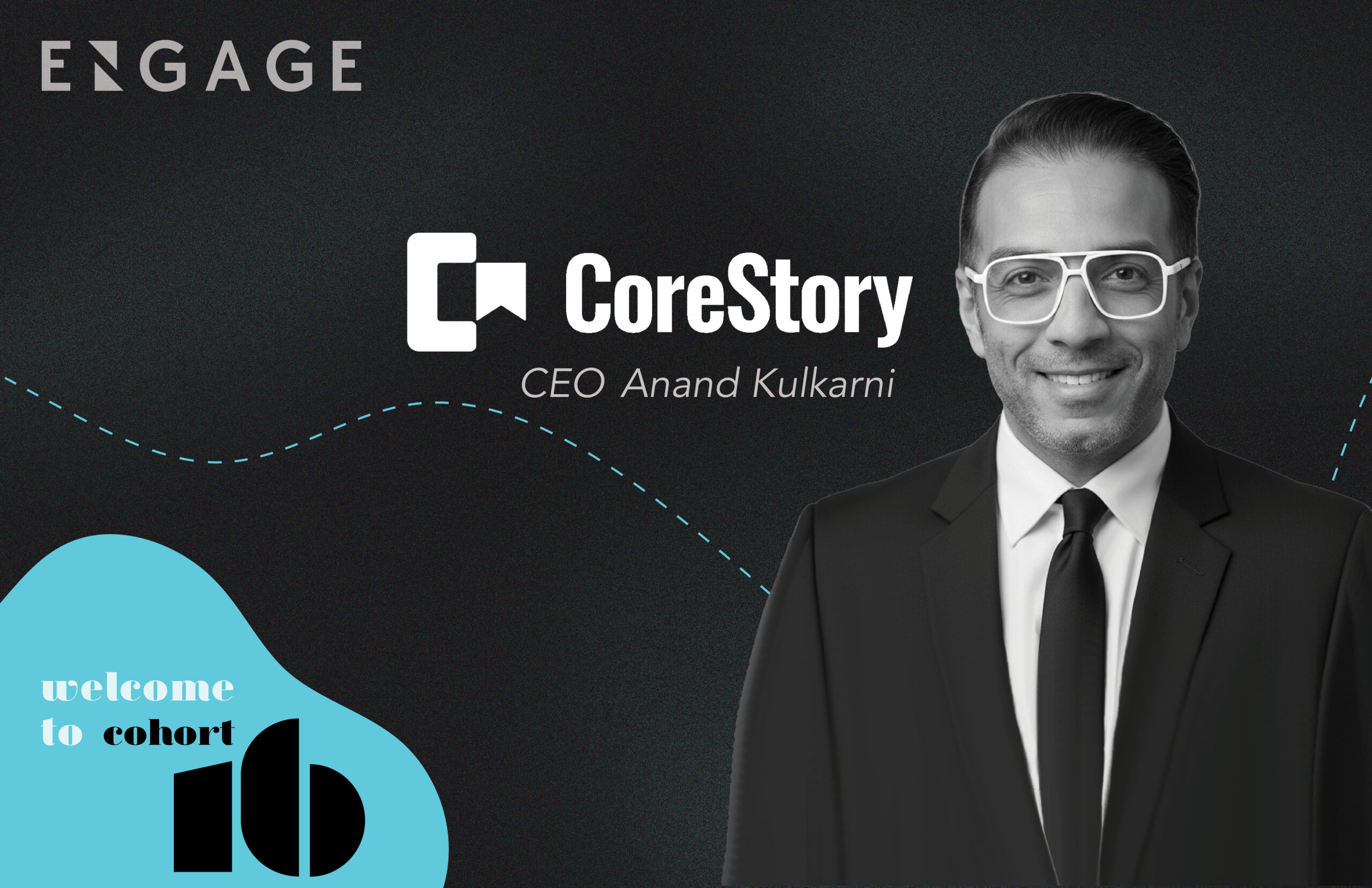
Where Academia Meets Entrepreneurship: Anand Kulkarni’s Path to CoreStory
Anand has never fit neatly into a single category.
He’s spent his career moving between research labs and startup war rooms, publishing ideas one moment and building companies around them the next. Where most people see academia and entrepreneurship as separate worlds, Anand sees them as part of the same process: discovering hard problems, then figuring out how to solve them at scale.
That blend of deep technical thinking and practical execution is exactly what led him to CoreStory.
Building AI Before the World Called It AI
Back in 2011, Anand was working on systems that looked surprisingly similar to what the world now recognizes as agentic AI workflows.
At UC Berkeley, where he was a National Science Foundation fellow studying AI and optimization, he built a platform called Turkomatic using Amazon Mechanical Turk. The system could break complex tasks into smaller subtasks, coordinate work across networks of people, and recombine everything into a finished output.
Today, large language models perform many of those same orchestration tasks automatically. At the time, Anand was doing it with humans.
“It was essentially an early version of ChatGPT workflows,” he said. “The same concepts now work with LLMs instead of human networks.”
That work became the foundation for his first startup, MobileWorks (later LeadGenius), a Y Combinator-backed company that helped create high-quality training data for machine learning systems. The company supported some of the earliest AI and computer vision applications including autonomous vehicles, long before AI infrastructure became mainstream.
His next company, Crowdbotics, expanded into software generation and requirements engineering by creating systems that could understand how developers describe applications and workflows.
That experience eventually led him to the realization that became CoreStory.
The Crisis Hidden Inside Legacy Software
Most enterprises today still run on decades-old software systems. Insurance claims, payment systems, airline operations, supply chains — much of modern infrastructure depends on legacy code that few people fully understand anymore.
And according to Anand, that’s becoming a societal problem.
“We think about crumbling bridges and roads as infrastructure crises,” he said. “But legacy software is infrastructure too.”
Most modernization efforts today rely on “transpilers,” which are tools that convert code line by line from one language to another. But Anand believed that approach fundamentally missed how humans actually understand software.
“Engineers don’t think in lines of code,” he explained. “They think in systems, components, workflows, and requirements.”
That insight became the foundation for CoreStory. Instead of directly translating old code into new code, CoreStory reverse engineers software into specifications first (requirements, modules, workflows, and architecture) before generating modernized systems from those specs.
The process creates far more visibility, verification, and trust along the way. In many cases, it replaces months of consulting work with an automated system enterprises can actually iterate on.
One of CoreStory’s large enterprise customers estimates that the technology saved 12 to 18 months of PM work, and benchmark studies concluded that using CoreStory to supercharge AI coding agents improves results by 44%, while lowering AI agents’ token consumption by 73%.
Bridging Research and Real-World Impact
What makes Anand truly unique is how naturally he moves between deep technical research and practical business execution.
He speaks about AI with the rigor of an academic researcher, but also thinks constantly about adoption, enterprise pain points, customer feedback loops, and commercialization. That combination has shaped how he approaches company building.
For Anand, success is no longer about raw growth metrics or user counts. It’s about solving meaningful problems at scale.
“I love taking hard technical problems and translating them into something that actually improves how the world works,” he said.
That perspective also shapes how he handles the emotional side of startups. After more than 15 years of building companies, Anand views entrepreneurship less like a sprint and more like a long-distance endurance sport.
“You can’t get too high or too low on any single day. The key is consistency.”
He credits outside perspective, exercise, coaching, and experience with helping him maintain that balance through the inevitable volatility of startup life.
A Different Kind of Accelerator Experience
Anand was also candid about what surprised him most about Engage.
Unlike many startup programs that focus primarily on networking or exposure, he quickly realized Engage operates differently because corporates are deeply embedded into the actual selection and diligence process itself.
“The companies helping evaluate startups are the same companies that eventually become customers,” he explained.
That alignment immediately stood out.
Within just a few weeks of joining the program, CoreStory had already received a dozen enterprise opportunities through Engage, which has been more traction than Anand had seen from almost any other investor relationship.
To him, that reflects something rare: a startup ecosystem built around genuine commercial demand rather than just venture signaling.
“It creates this meeting of minds,” he said. “The enterprises are actively looking for these solutions, and Engage is intentionally matching founders to real market needs.”
Anand’s Founder Equation
For Anand, startup success comes down to three things:
“At-bats + market insight + relentless iteration”
The more customer conversations you have, the more likely you are to find what truly resonates. But opportunity alone is not enough. Founders also need the insight to recognize real market pain, and the willingness to rapidly adapt once they uncover it.
“The first version is almost always wrong,” Anand said. “The key is learning fast enough to get to the right one.”
Recent Comments