
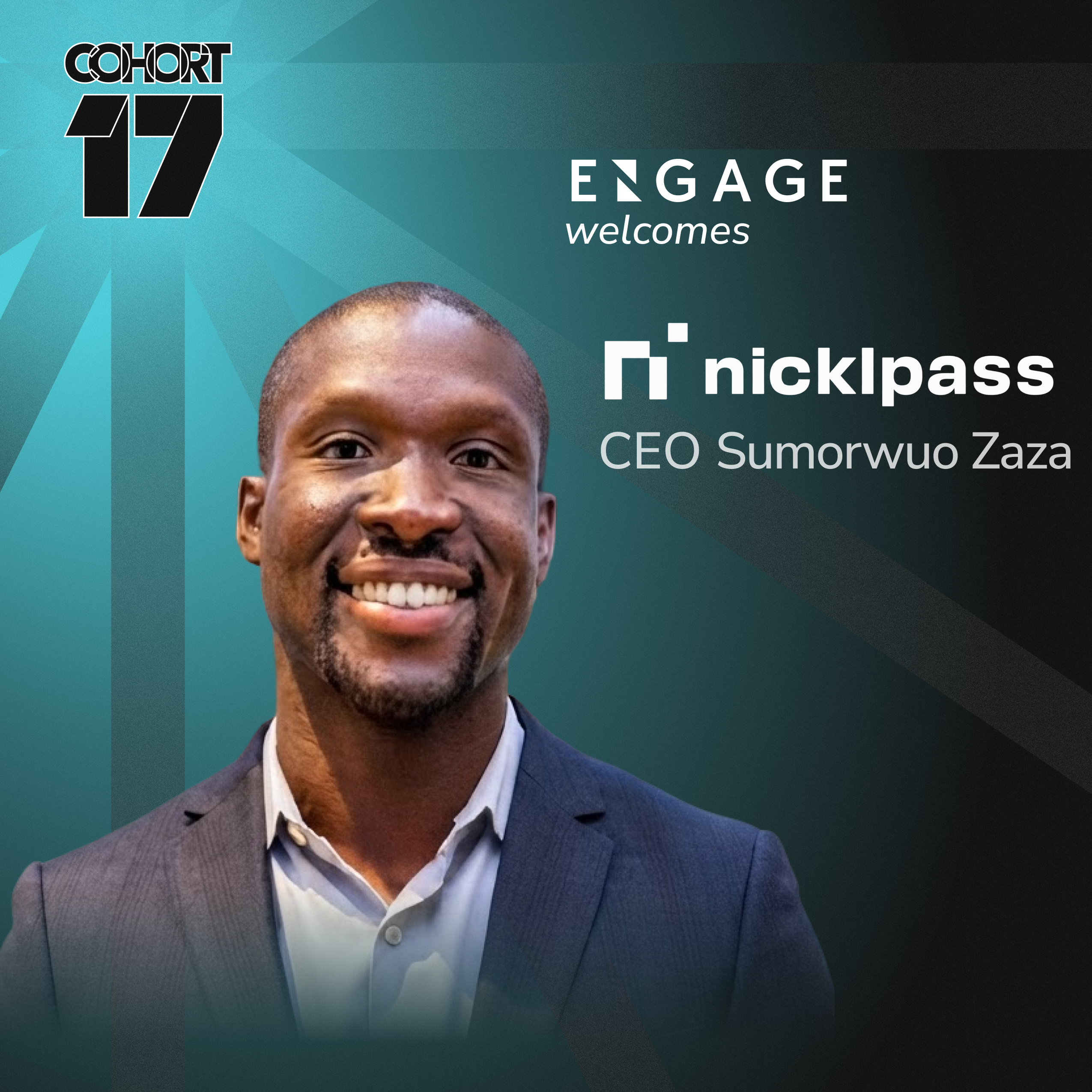
Taking Control of the Software Bill: The Story of Sumorwuo Zaza and Nicklpass
As a young analyst at Newark City Hall, Sumorwuo Zaza (“Zaza” for short) carried bags of candy everywhere he went. He had a habit of pushing projects forward before every approval was officially in place and when someone got upset about it, he’d apologize and hand them a Twix. Most government employees, he figured out, were chronically underfed after 2 p.m. It usually smoothed things over.
It was an early sign of the kind of leader Zaza would become, someone who would rather find a creative way around a barrier than wait for permission. Today, he is the Founder and CEO of Nicklpass, which helps companies, universities and other organizations see what they’re paying for across their software and digital subscriptions, cut the waste and get control of fast-growing AI spend. Getting there took about a decade and more than one rethink of the business model. As he puts it, “We’ve bobbed and weaved.”
Here’s a Twix
The first thing Zaza ever wanted to be was mayor of Newark, his hometown. Growing up, he watched two very different mayors run City Hall in two very different ways and he went on to intern for both of them. Those experiences taught him that he cared most about being impactful and effective. They also taught him that City Hall moved far too slowly for his liking.
So he found ways to speed things up. He’d push a project forward once people had given a verbal yes, which was usually enough to get the deal across the finish line even if it ruffled a few feathers along the way. That’s where the candy came in. “I like creating new things, and I like getting through barriers that are not really real,” he says. One of the programs his team created that first year was a tour of the Newark riverfront and its history. That program is still running more than 20 years later “because we basically didn’t take no for an answer.”
Grow Until You Break
After a stint in management consulting, Zaza was invited back to City Hall in 2012 to do more political work. But startups were taking off in New York and a small government-tech company called PublicStuff had just raised its Series A and was looking for people to help sell. Zaza had never done sales but he reached out to the founder anyway. He’d worked in government and in consulting and was confident he could figure out how to sell into government, as long as the company moved fast. It did and he rose from analyst to regional manager covering both coasts.
But what he loved most was the culture. It reminded him of the Peter Principle, which says that people keep getting more responsibility until they reach the level where they break. “If you don’t break, you just keep going higher,” he says. Somewhere in that climb, he realized he was always thinking less about how to do something 10% better and more about what the company would lose by not doing something at all. “For me, opportunity costs are what drives me to wake up in the morning,” he says. That’s when he started to think he might be an entrepreneur.
His next stop was the Huffington Post shortly after its $300 million sale to AOL, when Arianna Huffington was setting out to make it the biggest media brand in the world. Zaza was the first person tapped for the international expansion team and eventually became its vice president, building joint ventures with major newspapers in Japan, France, Spain and beyond. It was another place where you grew or you went home. Arianna would hand their team a project and the message was clear: deliver and get promoted, or don’t and be shown the door. “It wasn’t cash runway,” he says. “It was just career runway.” And he delivered.
A Tab for the Internet
Working with media companies around the world gave Zaza an early look at where the web was going. About a decade ago, most content and digital products were still free but publishers were just starting to put up paywalls, and he could see the trouble coming. If every site started asking for $10 or $20 a month, the promise of an open web would turn into a $200-a-month bill for every user.
So he got together with a few friends and mentors including leaders who had run big media companies, brought in a Google engineer to build the first prototype, and started Nicklpass. The vision then is still the vision today. Anyone at a company, university or nonprofit should be able to get what they need on the web and pay for it simply, with all of that spending and data brought together for the organization behind them. “It sounds really simple,” he says, “but it’s really hard.”
The first attempt was micropayments, paying a few cents per article. Investors loved the idea and some publishers liked it, but customers didn’t want to decide whether something was worth five or ten cents every time they clicked. What they really wanted was more like a bar tab: a set amount in their account, spent however they liked, with one bill at the end of the month. The trouble was that software prices were fixed, so the only way to keep users under their spending cap was to bundle. Four tools that cost $75 at retail could come in under $50 once Nicklpass pooled an employee with hundreds of colleagues and negotiated a group price.
It took almost six years to get the model and the technology right. Along the way, Nicklpass was awarded a patent on its bundling technology, one that covers not just news and information but any kind of software.
Every Customer Is Its Own Lego Set
Over the last 18 months, the company has evolved again. Audible backed the company and put them through a rigorous exit opportunity program which pushed the team to think harder about serving its customers. Meanwhile, Nicklpass kept hearing the same thing from its biggest customers including Visa, Disney and one of the world’s largest PR agencies. They saw Nicklpass as the company that saved them money on publications and they wanted that same approach applied to other kinds of software, and help getting a handle on AI spending (the line item growing fastest and most out of control). Usage-based AI billing, it turns out, works a lot like the tab Zaza imagined years ago.
He has always been drawn to what he calls “tragedy of the commons” problems, those no single company is motivated to fix on its own even though solving them makes the whole pie bigger. He sees paying for the web as one of them. Even the people who helped build the early internet have pointed out that it never figured out how to handle payments at its core. Zaza doesn’t plan to rebuild the browser. What his team does well is getting organizations to solve that problem for their own people.
That comes down to understanding people. Zaza describes some problems as “clock problems,” with precise, predictable parts, and others as “cloud problems,” which are messier and harder to pin down. “Human problems are all cloud problems,” he says, and anything involving AI and how people manage resources falls squarely in that category. After a decade of working through it, his team has gotten very good at managing every stakeholder involved: the software vendors, the buyer, the employees who use the tools and sometimes want different things, and the executives chasing their own goals. Instead of building one product that works for 80% of customers, they treat every organization differently. “You kind of have to look at every customer as its own Lego set,” he says, “and you’re using the blocks to build something new every single time.”

Right and Still Wrong
One of the biggest surprises of becoming a first-time founder was how hard it was to lose his identity. For years, he could tell people where he worked and what he did. As a founder, two things tend to happen when you describe what you’re building. Either nobody understands it or someone understands it perfectly and gives you a thousand reasons it won’t work. Learning to separate who he was from what he was building was a hard mental exercise, but one he believes every founder has to go through.
The other surprise was how often you can be right and still be wrong. In that first year, he ran projects perfectly and still didn’t get the result he wanted whether because an assumption was off, the team hadn’t done enough customer interviews, or they had the right product but the wrong business model. In most jobs, hard work earns you credit. “In founderdom,” he says, “you get an A for effort and an F for the work if it doesn’t deliver outcomes.”
Morale Burn
As he has matured as a leader, Zaza’s definition of success has shifted from himself to his team. In the startup world, it’s easy to believe everything revolves around the founder. “Then at a certain point, you realize, oh, you’re a very small piece of all of this,” he says. For most customers, the face of Nicklpass is someone else on his team so he spends a lot of time thinking about whether those people are growing, getting the stretch roles they want and feeling like they’re part of the win.
He calls it “morale burn,” and he tracks it as closely as cash burn. When morale is high, a team can do far more with less money. He even thinks about what the Nicklpass alumni network will look like someday because how former employees do says a lot about the company that shaped them. “It’s not about the exit,” he says. “It’s literally, are you really good at building companies and teams?”
That team-first approach has found its match in Engage. “I don’t want to say it’s changed everything, but it’s changed everything,” Zaza says. The program confirmed a lot of what his team already believed about selling to large organizations but it showed them in such a concrete way that Nicklpass now approaches all of its sales the way it approaches its Engage opportunities.
Zaza’s Founder Equation
Zaza starts with an idea most people have heard before: success is what happens when preparation meets opportunity. You can’t control opportunity but you can control how prepared you are when it arrives. He just takes it a step further by splitting preparation in two. Plenty of founders make sure they’re ready every time they walk into a room. The real magic, he says, happens when the whole team is that prepared. “Where things really start to go crazy is when you prepare the team in a way where they almost sound like the founder,” he says.
Personal Preparation + Team Preparation + Opportunity
The analyst who once carried bags of candy to get things done at City Hall has learned that the fastest way past any barrier isn’t a Twix. It’s a team that’s ready for anything.

Recent Comments