
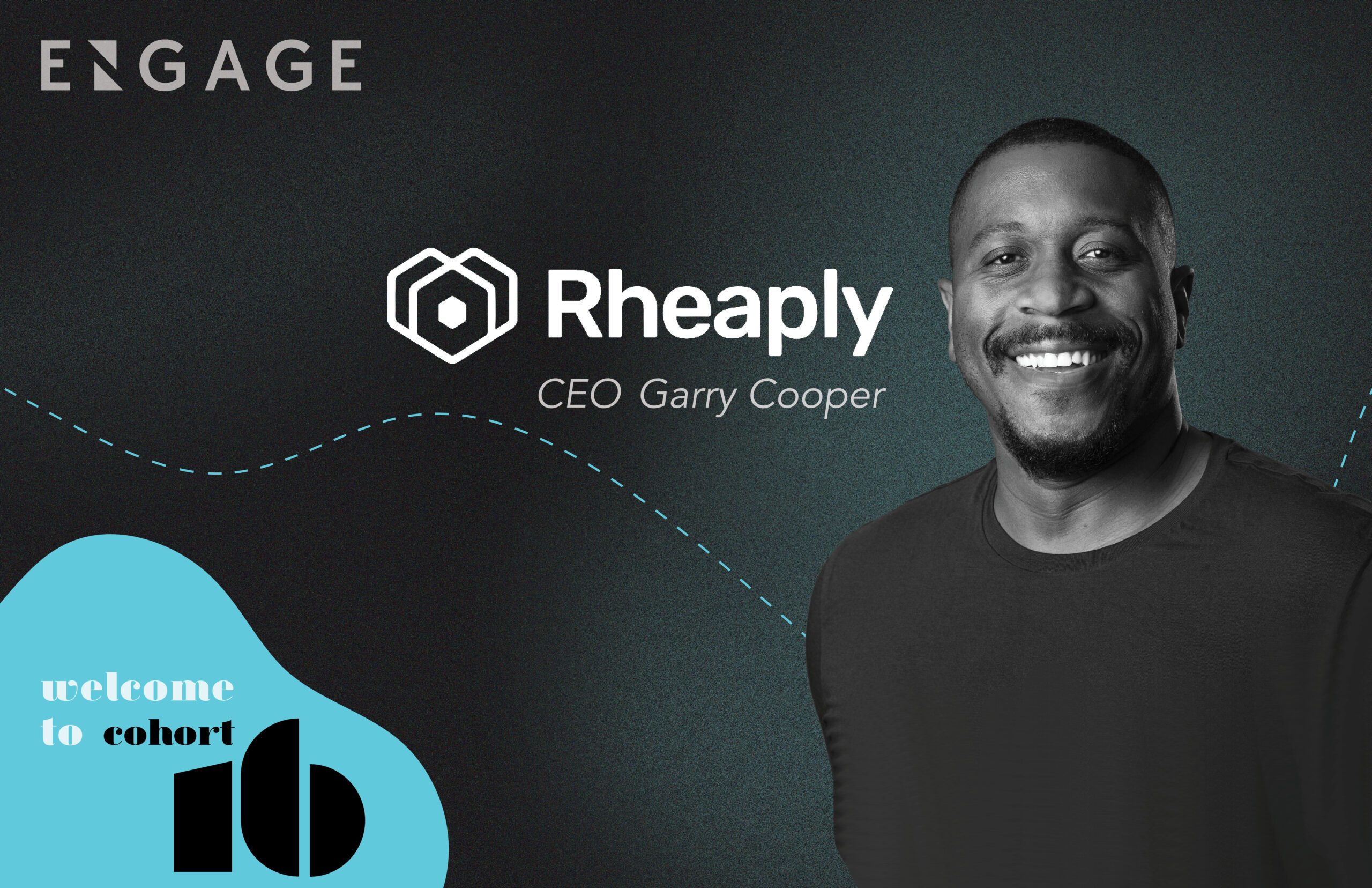
Building What We Overlook: Garry Cooper’s Journey to Rheaply
Garry Cooper has spent nearly a decade building Rheaply, but the company really started long before that in research labs and conversations about problems most people simply accepted as normal.
Before becoming a founder, Garry was a neuroscientist. He studied math and was a pre-med student at Indiana University before pursuing a PhD in neuroscience at Northwestern, where he was also part of a selective Kellogg program designed to help scientists develop business and leadership skills. Growing up, he thought careers fell into a few categories: doctor, lawyer, pastor. Becoming a scientist, let alone an entrepreneur, wasn’t something he had seen modeled around him.
What drew him toward science wasn’t just discovery. It was impact.
He spent years researching Parkinson’s disease and reproductive cancers, eventually working across both academia and large pharmaceutical companies. And across every environment, he noticed the same thing: extraordinary amounts of waste hiding in plain sight.
Lab equipment sitting unused in hallways. Perfectly usable supplies forgotten in freezers. Shelves filled with materials purchased for experiments that never happened.
“Science is not an endeavor of conservation,” Garry explains. “It’s an endeavor of discovery.”
Researchers aren’t incentivized to save money. Their job is to solve hard problems. But the scale of unused resources is impossible to ignore.
Seeing the Problem Differently
Around 2015, two things collided in Garry’s mind.
The first was the rise of the “sharing economy.” Companies like Airbnb and Uber had fundamentally changed how people thought about access versus ownership.
The second was the growing urgency around climate change and the circular economy. Garry became particularly fascinated by work from the Ellen MacArthur Foundation, which argued that renewable energy alone would not be enough to meaningfully reduce carbon emissions. The world also needed systems built around reuse.
At the same time, Garry and his team conducted a large survey of scientists at Northwestern. The findings were staggering: roughly 80% of researchers estimated they had at least $5,000 worth of surplus inventory sitting unused every year.
The problem wasn’t scarcity. It was visibility.
Organizations had built incredibly sophisticated systems for buying new things. Procurement technology stacks made purchasing effortless. Global logistics systems could deliver products overnight, sometimes within hours.
But almost nothing existed to help organizations understand what they already had. That became the foundation for Rheaply.
Building the Infrastructure for Reuse
Rheaply started with a deceptively simple idea: make reuse easier than buying new. Garry often describes it as helping organizations “shop their own closet” first.
Today, Rheaply helps large organizations manage and redistribute underutilized assets across labs, offices, campuses, and facilities. Their platform gives organizations visibility into inventory that would otherwise sit unused, helping reduce waste, lower procurement costs, and minimize unnecessary carbon emissions.
The company’s product, Visibility, tackles what Garry believes is one of the biggest hidden inefficiencies inside enterprises. Valuable assets that technically exist, but might as well not because no one knows where they are.
And while the concept sounds intuitive, building the business has been anything but easy.
“The linear economy is a strong force,” Garry said. “It’s really easy to purchase.”
Changing behavior, especially inside massive organizations, requires more than good intentions. It requires creating systems that are genuinely more convenient, intuitive, and scalable than existing workflows.
That philosophy has guided Rheaply for nearly ten years.
A Founder Built for Complexity
One of the most striking things about Garry is the way he talks about difficult problems. There’s no startup bravado. No exaggerated optimism. Just a deep sense of responsibility toward the work.
Over the course of building Rheaply, there were multiple moments where walking away would have been understandable. Garry spoke candidly about periods during both graduate school and while building the company where he questioned whether he could continue.
What kept him going was perspective.
At one point in our conversation, Garry referenced a quote from Oprah that has stayed with him for years:
“When the winds of life are turned against you, ask what is this here to teach me?”
That mindset seems to shape the way he approaches leadership and adversity. For Garry, hard problems are not signals to quit. They’re often signals that the work matters.
“Some good people have to be on the front lines fighting for the good thing,” he said.
Over time, his definition of success has evolved too. Early in his career, success looked like financial security and stability. Today, it looks more like leverage and impact, creating systems where one hour of effort can generate meaningful value for communities, institutions, and future generations.
That perspective also explains why Garry continues to stay deeply involved in the Parkinson’s community, serving on the board of the American Parkinson Disease Association and supporting caregivers navigating incredibly difficult circumstances.
The mission has never just been about software.
Building for the Long Term
After participating in several accelerator programs over the years, Garry described Engage as refreshingly practical.
Rather than focusing heavily on product tweaks or theoretical growth strategies, Engage met Rheaply where the company actually was, as a mature startup focused on scaling enterprise adoption and securing contracts.
The experience centered around warm introductions to organizations that already understood the problem Rheaply was solving and aligned with the company’s broader mission around sustainability and operational efficiency.
That stage-aware approach stood out to Garry, particularly after nearly a decade of building.
Garry’s Founder Equation
The problems Rheaply is solving sound simple on the surface. In reality, they touch procurement systems, sustainability goals, behavioral psychology, logistics, operations, and institutional change all at once.
As Garry put it: “We don’t make hot dogs.” And when asked what drives success as a founder, he points to these three things:
“Passion & grit + Vision + Curiosity for complexity”
For him, founders have to genuinely enjoy wrestling with difficult, layered problems especially when solutions take years to fully materialize. Passion helps sustain the work. Vision keeps the direction clear. And curiosity makes the complexity energizing instead of exhausting.
Nearly ten years into the journey, Garry still speaks about the work with the same thoughtful conviction that started it. Not because it’s easy.
Because he believes the problems worth solving rarely are.
Recent Comments