

Fighting for Every Drop: The Story of Jahanzeb Khan and 4Earth
In 2013, Jahanzeb “Jahn” Khan was ranked number two in Georgia in his mixed martial arts (MMA) weight class and was one fight away from turning professional. The photo shoot was already done and the plan was to win the 145-pound title, make it big in fighting and use that platform to help solve problems he’d cared about his whole life, like access to clean water and energy. Then, after a philosophical change of mind, he walked away from the cage for good.
Today, Jahn is the Founder and CEO of 4Earth, which designs, engineers and manufactures complete, packaged water treatment plants at its factory outside Atlanta, then ships them to factories, municipal plants and data centers where they can be set down, plugged in and put to work. He didn’t give up the fight to solve those problems. He just found a more direct way to take them on.
Water, Energy, Food
Jahn’s story really starts with his father, who immigrated to New York in the 1970s with a background in machining, manufacturing and entrepreneurship. Like so many immigrant families, his went through a lot to build a life here. Jahn grew up watching that, deeply appreciating what his parents sacrificed for him. Manufacturing, it turns out, runs in the family, though he admits he didn’t fully realize it until later in life. “It’s kind of in my blood,” he says.
After a few years in New York, his father moved to Washington, D.C., married Jahn’s mom, and raised their family in Virginia and D.C. From a young age, his parents instilled in him a deep respect for the basic resources that keep society and industry moving like water, energy and food. It was a lesson that stuck long before he knew what he’d do with it.

Leaving the Cage
Jahn was an athlete for most of his life, playing football and running track before finding his biggest sport, MMA. He kept fighting while studying engineering at Georgia Tech, and with MMA’s popularity taking off, everything seemed to be lining up for a professional career.
But somewhere along the way, possibly during that last fight, he started thinking more deeply about what he was doing. “Smashing people for a living in front of their family, risking myself,” he says. He had what he calls “a philosophical change of mind,” and decided he could make a bigger difference by taking a more direct path through technology, business and engineering. He stepped into the cage for the last time in December 2013.
Fortunately, he was already well positioned to make the switch. After finishing his degree, he stayed at Georgia Tech to pursue a PhD blending process engineering, machine learning and materials science, all applied to water, wastewater and energy. At the same time, he was getting hands-on industry experience doing business development with industrial customers for a large overseas manufacturer expanding into the U.S. while designing, building and operating multiple projects.
The 4 in 4Earth
The more time Jahn spent in the field, the clearer the problems in the water industry became. Solutions were slow, complicated to use and maintain, and far too expensive. Very little new technology was making its way in and much of the experienced workforce was retiring, something he saw happen to people he knew. On one project at a plant in Georgia, he watched construction drag on for three or four years and wondered why it had to take that long and cost that much. With manufacturing in his background, the question that followed was simple: could at least part of this be built in a factory and delivered as a product?
He also spent a lot of time with plant operators and maintenance crews, learning what frustrated them, how they thought and how they made decisions. “I think that gave me a lot of empathy into designing technology that’s good for an operator, that’s good for a maintenance person,” he says, “which I think is also lacking in many industries.”
The idea had been building for a couple of years and so had the itch to start something. Then, two months after Jahn’s wedding, his 19-year-old cousin who was like a brother to him, passed away. His cousin had been planning to start a company with the number 4 in its name, and the loss changed how Jahn saw his own timeline. “He was 19,” he says. “You never know what’s going to happen. So whatever you want to do, just make it happen.”
About a year away from defending his thesis, Jahn realized he didn’t need to finish his PhD to do what he wanted to do. He left the program and in 2020, just a month before the pandemic, launched 4Earth, naming it in honor of his cousin to keep his legacy alive. It’s not a story he shares often.
Built in a Barn
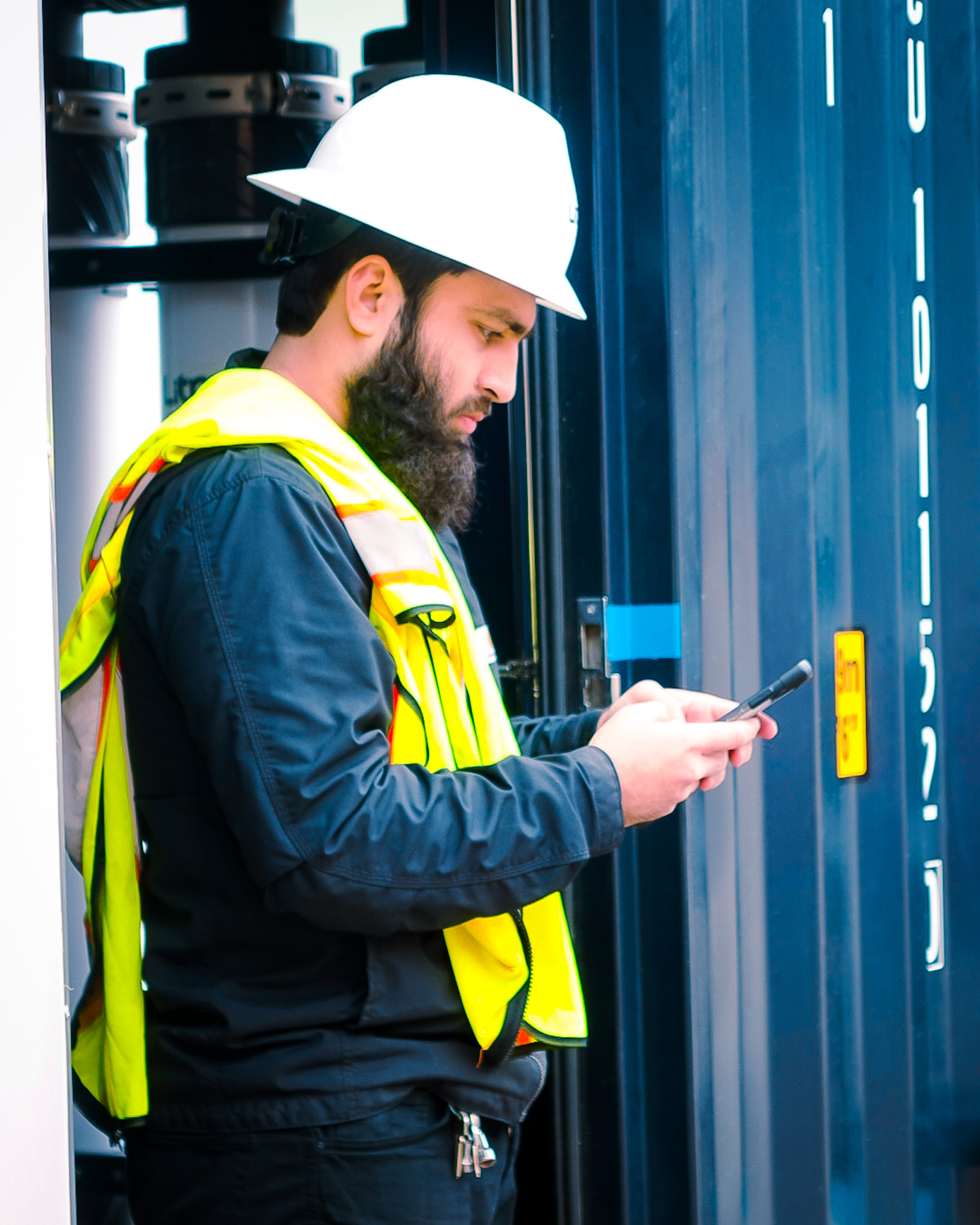
In the early days, 4Earth was Jahn and a few key builders, engineers and designers he had recruited, working out of an old, rustic barn-like facility that was open to the elements. “If it’s hot outside, it’s hot inside,” he says. Jahn was right there in the shipping container with the team, pulling wire, designing and running pipe, then getting each system into the field, testing it and doing it all again. With process, software, hardware and automation all coming together from day one, plus supply chain, quality control and customers to manage, he regularly worked 100-hour weeks.
One of the first people to join him was his younger brother, Gulzeb, who had been doing sales at a software company in D.C. and came back home when COVID made everything remote. He walked into that barn and started pulling wire and piping right alongside Jahn and today he is 4Earth’s Chief Commercial Officer, leading branding, commercial strategy and design. Growing up close and loyal as the only two kids in the family, they can be completely honest with each other, which Jahn believes has made the whole company more open. Gulzeb also has a great eye for design and user experience and shares Jahn’s vision of making 4Earth’s systems feel as clean, simple and minimalist as an Apple or Tesla product.
The hardest stretch in the company’s history came in 2024, when an industry partner called with a Mercedes project that needed a system in three weeks. A full machine normally takes 8 to 12 weeks to build for 4Earth, which is already much faster than industry norms. Jahn told the team it would be hard but they could do it, and for three straight weeks they worked 105+ hours a week, designing, sourcing, building and testing the entire system before Mercedes came to the factory to make sure everything worked. “It was like a movie,” he says. “High pressure, high stakes.” It pushed the team to another level and after meeting the quality bar of an automaker, they came out believing they could take on anything.
Lead with Cost
Today, 4Earth has a much bigger team, a much bigger factory and fully automated systems built with modern design and AI tools, but the core idea hasn’t changed. Instead of a customer spending years and tens of millions of dollars on construction, 4Earth builds the entire treatment plant in its facility and ships it ready to go. At a factory, the system takes wastewater from the production process, treats it and sends it back into production, a cooling tower or other reuse. At a water treatment plant, it can quickly add capacity and improve contaminant removal for a fraction of the cost of new construction. And with the data center boom, 4Earth can turn wastewater or groundwater into cooling water, easing the pressure on city water supplies, lakes and rivers.
While sustainability is a big part of the story, Jahn knows that’s rarely what gets a customer to change. “Every business, every organization understands cost,” he says, so 4Earth always leads with how much it can save and the environmental benefits follow. The second part of the pitch is simplicity. Rather than hiring five or six different construction, engineering and automation companies, a customer can work with one company that delivers what Jahn likens to a MacBook. A single product that’s easy to use and maintain and does the job.
The team behind it is a deliberate mix, too. 4Earth pairs Georgia Tech engineers who are fluent in AI and automation with people who have spent years doing operations and manufacturing in the industry, and Jahn believes bringing those two mindsets together is what makes the product experience unique.
Building Atlanta
As 4Earth has grown, Jahn’s role has shifted from pulling wire to building strong leaders across each part of the company and the teams around them. He has also taken on fundraising and found creative ways to finance projects, along with much of the company’s founder-led sales, often learning what he needs the night before. “You have to be a lifelong student,” he says. “You’ve got to be humble, learn from anybody and apply those things.” Over the next few years, he hopes to step back from day-to-day sales and spend more of his time zooming in on whatever bottleneck is holding the company back, solving it and moving on to the next.
He could have built 4Earth anywhere but staying in Georgia was personal. With Georgia Tech and other universities nearby and big manufacturers announcing new initiatives across the state, he believes something special is happening in Atlanta and wants 4Earth to be a big part of it. He even opened a separate machining company to help other hardware startups make parts and design products that are easier to manufacture. “Instead of waiting for 20 years,” he says, “this has to happen right now.”
Engage has reinforced something he already believed, that relationships are everything. “At the end of the day, it’s a corporate, but you’re dealing with a human being,” he says, and looking back at 4Earth’s past deals, every one of them came down to trust. The program has helped him double down on building that trust, and its warm introductions have already turned into next steps and site visits with several of Engage’s corporate partners.

Jahn’s Founder Equation
Every morning when his dad dropped him off at school, he told Jahn the same thing: be the best at what you do, be number one. Hearing that every day as a kid and then fighting in a cage where giving up wasn’t an option, gave him a mindset he still carries and one he’s now trying to pass on to his own son. For Jahn, success still means being number one in his field. When people think of chips, they think of NVIDIA, and he wants people to think of 4Earth the same way when it comes to water. The catch, he admits, is that with that mindset you never really arrive. “Wherever you’re at, there’s another level,” he says, and he reminds his team of that, too.
Building a company has brought some very low lows, but he has always believed there was a way through them. He’s an optimist by nature and knows his team takes its cues from him. “If you’re commanding a ship and people are looking at you, and you’re out, they’re going to be like, okay, I’m out too,” he says. What keeps him grounded is his faith along with time with his wife, son and friends. And when stress builds, his answer is to act. “The best way to conquer stress is action,” he says. “If I do something, I’m not stressed.”
So when asked for his equation for success, Jahn starts with gratitude. “I believe everything that I have comes from God, and I’m really grateful for that,” he says. Next comes a maniacal work ethic, sweating the details and putting in the time. And finally, empathy for customers, employees and the industry. The same empathy he built sitting with plant operators years ago. “When you have empathy,” he says, “you understand humans and the world in a different type of way.”
Gratitude to God + Maniacal Work Ethic + Empathy
Jahn walked out of the cage more than a decade ago, but he never stopped fighting. He just chose a fight that matters to all of us.
Recent Comments