
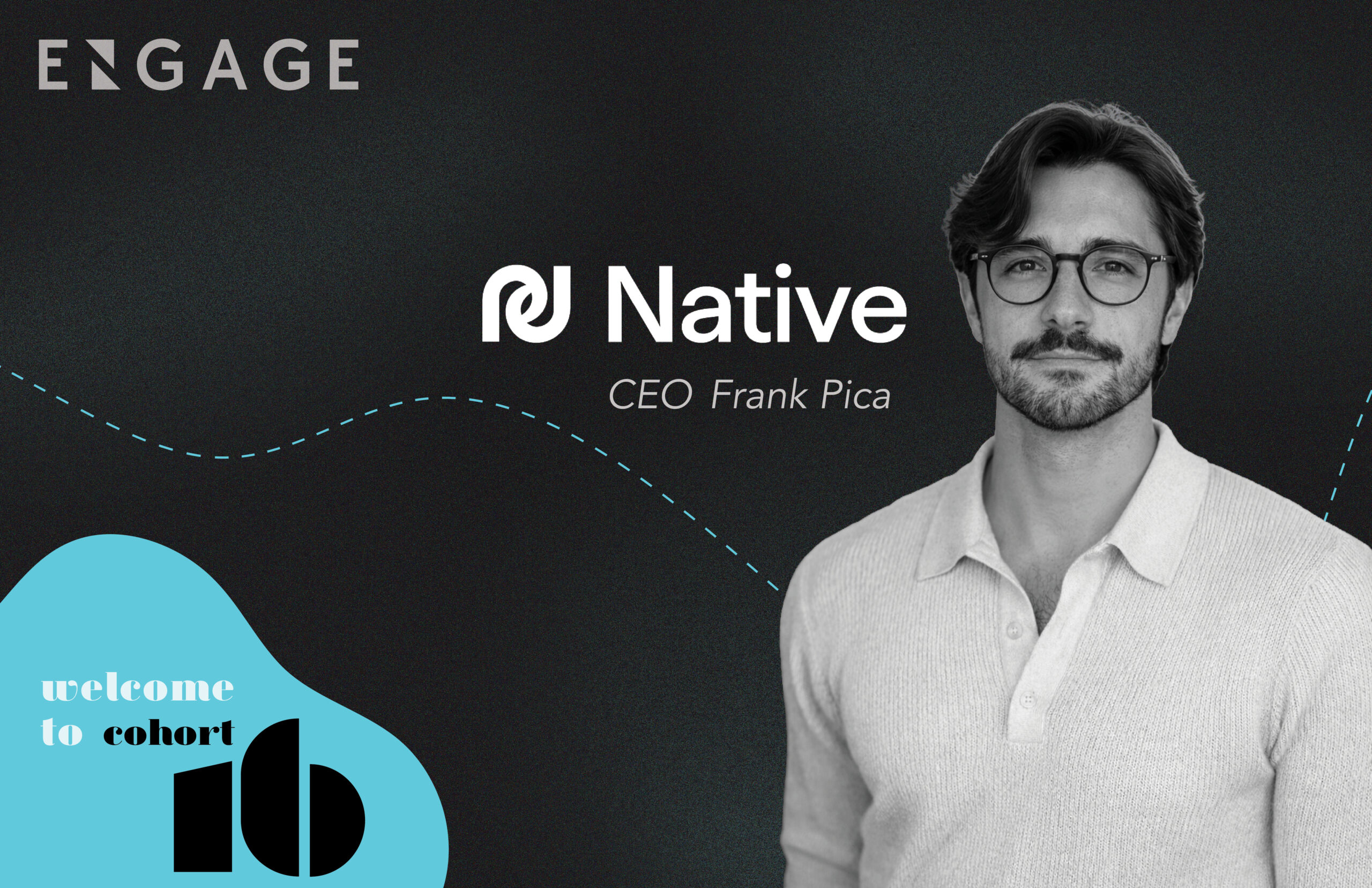
From Soccer to Startups: Frank Pica’s Journey to Native AI
For a long time, Frank Pica thought his life would be measured in seasons, games and goals scored.
Soccer wasn’t just a hobby, it was the plan. He played at the collegiate level and planned to go pro, structuring nearly every decision around that goal. Then, during his senior year, a series of injuries abruptly ended the career he had spent years building toward.
“It was probably the most frustrating period of my life,” Frank says. “Everything I had worked toward was tied to soccer.”
What followed wasn’t a clean pivot into tech. It was a full identity reset.
Learning to Build Instead of Compete
Trying to stay close to the sports world, Frank joined LockerDome, a sports-focused social media startup, as the company’s third employee. It would become his crash course in startups.
Over the next six and a half years, he helped scale the company from three people to more than 150 employees and from zero to over $70 million in revenue. Along the way, the business evolved from a consumer sports platform into a performance advertising technology company, eventually rebranding as Decide.
The experience gave Frank something soccer never could: exposure to how products get built, how companies survive, and how quickly markets can change.
He later joined a European advertising technology company headquartered in Paris, where he was tasked with building out U.S. operations. At the time, the company was experimenting with some of the earliest forms of NLP-powered advertising optimization using IBM Watson-era technology, years before generative AI became mainstream.
Around the same time, he also consulted for Vertebrae, an AR/VR startup later acquired by Snap, where he was exposed to emerging computer vision technologies.
Those experiences — natural language processing on one side, computer vision on the other — eventually collided into a single idea.
Betting on AI Before the Market Was Ready
Frank founded Native AI around a thesis that sounded almost futuristic at the time. What happens when you combine computer vision and NLP deeply enough to create digital twins of human behavior?
“Could we actually clone human behavior well enough to help organizations make better decisions before those decisions reach the real world?” he remembers asking.
Today, that question feels far less abstract. But when Native started more than six years ago, the market wasn’t ready for it.
The technology often felt too advanced for customers to fully understand. Frank says many early conversations ended with people assuming the product was more “magic trick” than software. To gain traction, Native initially narrowed its focus into specific verticals, slowly building credibility while continuing to refine the platform behind the scenes.
Then ChatGPT launched.
Suddenly, the market caught up to what Native had been building for years.
“We had customers come back and say, ‘You were talking about this three years ago,’” Frank says.
That shift dramatically accelerated adoption. As large language models became mainstream, Native’s core technology that understood populations, behaviors, and decision-making at scale started making immediate sense to enterprise customers.
Reimagining Research and Representation
At its core, Native helps organizations better understand people.
Traditional market research often relies on surveys, focus groups, or third-party research firms that can take weeks or months to produce insights. Native’s platform allows organizations to interact with AI-generated population models in real time, dramatically speeding up how insights are gathered and applied.
But for Frank, the bigger opportunity is not just efficiency. It’s representation.
He believes traditional research systems often fail to capture diverse perspectives, particularly among Hispanic and Black communities that are historically underrepresented in expensive, opt-in research models.
“Those voices are often missing from the data,” he says.
Native’s approach allows companies to model populations more broadly and inclusively, creating what Frank sees as a more accurate understanding of real-world behavior.
But for Frank, research and insights was never the final category, just the proving ground. The larger ambition is to build a simulation layer for human behavior, one that enterprises can use to test ideas, predict responses, validate assumptions, and make better decisions anywhere human judgment, preference, or behavior shapes the outcome.
At the same time, he is acutely aware of the ethical responsibility that comes with building powerful AI systems. Native maintains strict guidelines around the organizations it works with and how the technology is applied.
“We want to work with companies genuinely trying to create better products and services.”
Surviving the Hard Parts
Like most startups, Native’s path has been far from linear.
The company has faced multiple moments where survival was uncertain including almost running out of money several times, navigating major infrastructure outages, and enduring the constant pressure that comes with building ahead of the market.
Frank doesn’t romanticize those moments. “There’s no secret,” he says. “You just develop a higher tolerance for pain over time.”
What matters most, he believes, is maintaining clarity when things go wrong. Not panic. Not emotion. Just finding the next path forward.
That mindset has become foundational to how he leads Native today. The company has survived long enough to develop something many startups never get — scars. And in Frank’s view, scars matter.
“Your odds of survival improve every year you’re still standing,” he says.
Why Engage Felt Different
Frank initially approached “accelerator” programs with skepticism. He had seen enough startup ecosystems to know that not all programs create meaningful outcomes.
Engage felt different.
What stood out most was the quality of the corporate network and the calm, grounded approach of the team running the program. He saw Atlanta not just as an emerging tech ecosystem, but as a place where real enterprise relationships could be built.
For a company like Native sitting at the intersection of enterprise AI, research, and ethical data, that mattered.
Frank’s Founder Equation
After years of building through uncertainty, Frank has a pretty clear view of what separates founders who survive that rollercoaster:
“An insanely acute vision + Luck + High tolerance for pain”
The ability to see where markets are heading before others do, the right market moment, and the resilience to survive the years in between.
Recent Comments