
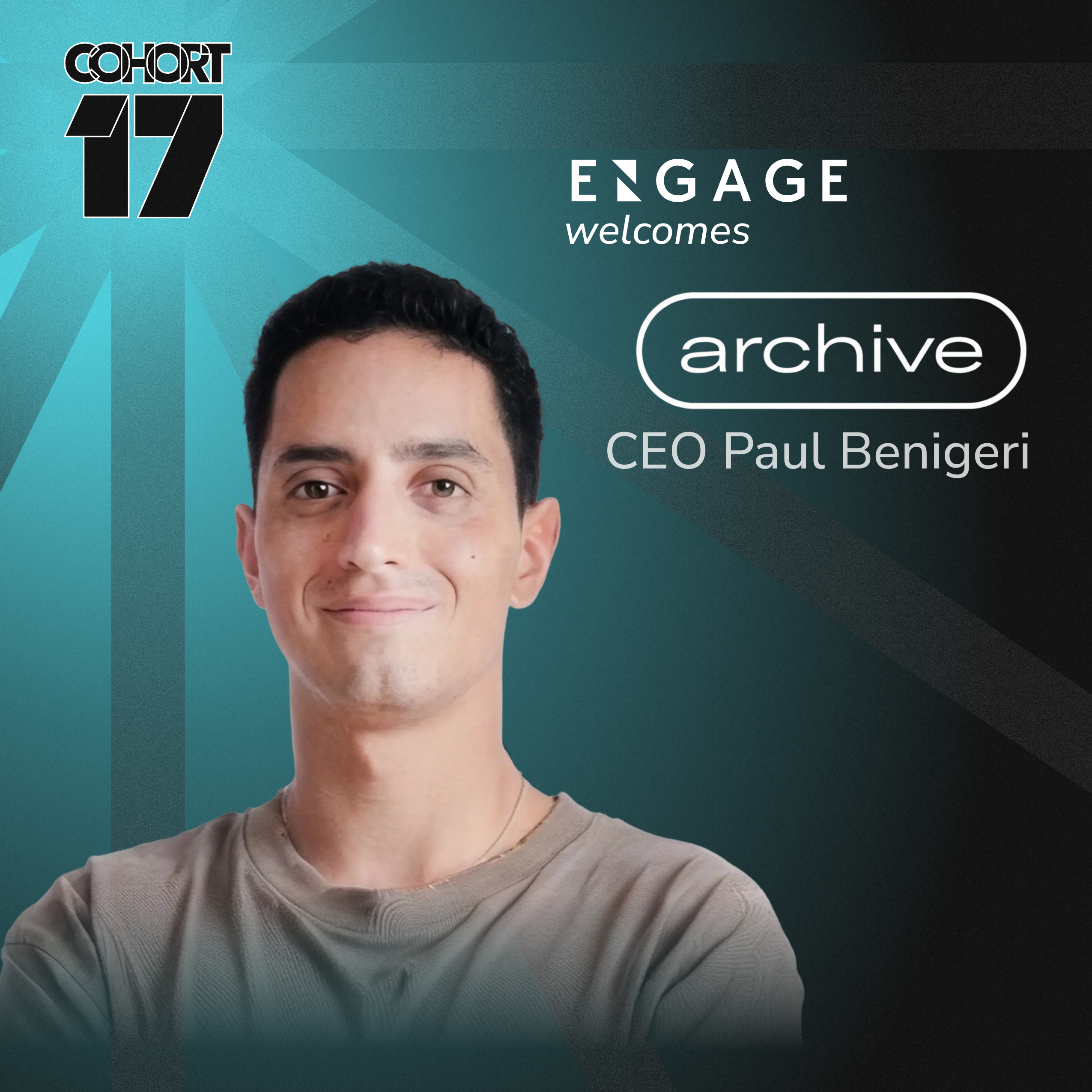
Watching 20 Million Videos a Day: The Story of Paul Benigeri and Archive
Paul Benigeri remembers the moment clearly. His co-founder, Geoff Woo, was practically shouting at him that their influencer marketing was working and that Paul needed to scale it. Paul asked if that meant hiring ten more people. Geoff said no. So what, exactly, were they supposed to do? It was the best-performing channel they had and it was almost impossible to grow.
Today, Paul is the Co-Founder and CEO of Archive, which builds AI-powered creator marketing software for brands. Its platform watches some 20 million social videos a day and its AI agents can now run creator marketing from start to finish. In other words, Archive is the answer to the question Paul couldn’t answer back then.
Building His Own Things
By 16, Paul was already coding iPhone apps and putting them on the App Store, and his dream was to one day work at Apple. Then he met someone who had interned there and described what he worked on. It sounded so small to Paul that the dream fizzled on the spot and he got excited about building his own things instead.
He went on to study AI and computer science at Stanford where his entrepreneurial streak only grew. He started a couple of crypto businesses and even a gasoline delivery company. And while not all of them worked out, each one taught him a little more about what it takes to build a company from nothing.
Two Engineers Selling Ketones
After Stanford, Paul joined Geoff at Ketone-IQ, the consumer packaged goods company now doing about $60 million a year. It was a funny fit at first though. Two Stanford AI and computer science guys trying to figure out how to build a CPG brand. Building the technology and the website was the easy part. Getting anyone to actually buy the product was not.
“There’s two things that are hard,” Paul says. “Number one, you’ve got to make a product that people want. And number two, you have to get distribution.” They had been entirely focused on the first. So Paul went from engineering to teaching himself everything about marketing, growth and distribution, from PR to Facebook ads to finding YouTube reviewers himself. That’s how he landed in influencer marketing and how he learned just how manual it was. Videos were scattered across platforms, results were nearly impossible to track, and the only way to do more was to throw more people at it, even though it was working better than anything else they’d tried.
Everyone Wanted the Playbook
When COVID hit, Paul and Geoff left Ketone-IQ full-time and started a holding company, bootstrapping it in a way they hadn’t quite planned. Their friends had seen how well the Ketone-IQ influencer program worked, and they all wanted to know how they had scaled it. So Paul and Geoff started an agency to run creator programs for other brands. As it turned out, a systems engineering background made it much easier to turn influencer marketing into a channel that could actually scale than a traditional marketing background did.
The agency eventually worked with more than 25,000 influencers and reached about $200,000 a month in revenue, which brought a whole new level of problems. They started building software just to keep up. Around the same time, friends of theirs were building powerful new AI models at companies like Anthropic and OpenAI, and Paul and Geoff realized that the same technology could do more than help them run the channel. It could automate it completely. That idea became Archive.
An Oracle for Brands
In the early days, Archive tracked thousands of videos. Today, it processes about 20 million a day and its customers have grown from small brands to some of the biggest companies in the world. That kind of scale means Archive is effectively watching years’ worth of content about each brand every single day, something no team of people could ever do. “We know a lot more about these brands than they know about themselves,” Paul says, “and that’s why we create so much value.”
Archive’s deep research tool can analyze 25,000 videos in three to four minutes, the equivalent of watching hundreds of thousands of hours of content along with all the comments. Those comments are where Paul believes the real truth lives. “These aren’t product pages that are gamified,” he says. “These aren’t fake user interviews or testimonials. This is actually people talking about you and your company and your competitors.” Customers tell him it feels like having access to an oracle, one that can tell them what their consumers are seeing, what their competitors are doing and how people are reacting to them.
Archive began as a new kind of social listening built for short-form video. Once the team had all that data, they realized it was the secret ingredient for building great AI agents. Now, on top of that intelligence, Archive runs creator marketing end to end, with agents that can do the work of an entire agency’s worth of influencer marketers, faster and at a lower cost.
The More AI Slop, the Better
The biggest surprise along the way was where all that data would lead. Paul originally expected to use it to build AI influencers. Instead, the opposite happened. Low-quality, AI-generated content, what most people now call “AI slop,” flooded social feeds so quickly that it pushed trust back toward real people faster than anyone imagined. “The more AI slop there is, the more valuable the remaining authentic human creators are,” he says.
When Paul talks with the CMOs of some of the world’s best-known brands, they’re laser-focused on telling stories built on trust and right now, creators are the only way to do that well. In a strange twist, AI has made human creators more important than ever and Archive is using AI to help brands find and work with them.
A Bridge of Hope
Paul had been a founder before and even CEO of a few companies that didn’t make it, but Archive is the first high growth company he has led as CEO. The way he describes the job now is a little unexpected. A CEO, he says, has to lay down a “bridge of hope” for investors, employees, partners and customers, a promise backed by so much conviction that people will believe in it for the next two, three or four months. That buys the team the right to go build it, and then to do it all again for the next wave.
So much of what Archive does today once seemed impossible. Could they really watch 20 million videos a day? Could AI agents really run an entire marketing channel? “We just had to take the shot and bet on ourselves, even though there was no clear outcome,” he says. As the company grows, the stakes get higher, the timelines get longer and more people are counting on the bet paying off. “But you really have to just invent the future and go try to make it happen.”
His definition of success keeps growing right along with it. Once you cross your first $1 million, you start thinking about $10 million. Once you cross that, you’re thinking about $50 million, and a $1 million side project starts to feel too small to bother with. It took Archive a long time to earn its first million. Now it adds roughly that much every month. “You earn the right to work on bigger problems,” Paul says.
Skeptics on Both Sides
Paul is candid that when Archive first connected with Engage, neither side was sure about the other. They traded a few materials and kicked the tires. Then came a call with Coca-Cola and something shifted. There were senior people on the call Paul had never had access to before and Coca-Cola was excited enough to move quickly toward a pilot. “At that point, I think we realized, whoa, Engage actually has this network,” he says.
From there, the two sides worked out terms and got to work, and Paul likes to think both sides have overdelivered on the promise. The meetings have been strong, the Engage team has helped Archive sharpen its positioning and conversations, and nearly every company Archive has met through the program has wanted to keep talking. “We showed a lot of enterprises that they’re missing out on a lot of value,” he says.
Paul’s Founder Equation
Paul’s equation starts with curiosity, the same “what if” that has driven every big bet Archive has made. What if we could build this? What if we could watch 20 million videos? What if the agents could do the whole job?
The next two go hand in hand. There’s hard work, the sheer number of hours it takes. And there’s perseverance, because the ride never really smooths out. “On a Monday, you can get the worst news ever,” he says, “and you just got to go to sleep because you got a whole team counting on you to be back at it the next day.” Then on Tuesday, you do a couple of extra things and close the biggest deal you weren’t expecting. His strategy for handling it is refreshingly simple. “Just go to sleep,” he says. “You go to sleep, and it’s less bad.”
Curiosity + Hard Work + Perseverance
Years ago, Paul couldn’t scale a channel that was working without hiring an army of people. Now he’s built the software that does the job of that army.
Recent Comments